Toronto International Film Festival 2018 - UPDATE #7
Phoenix
Directed by Camilla Strøm Henriksen
NORWAY/SWEDEN/86 MINUTES/DISCOVERY
 Phoenix stars Ylva Thedin Bjørkaas as Jill, an affable 13-year-old who has essentially assumed the role of caregiver for her younger brother (Casper Falck-Løvås' Bo) - as the pair's mother (Maria Bonnevie's Astrid) is an irresponsible alcoholic with little interest in providing a safe, comfortable home for her children. It's familiar stuff that is, especially at the outset, employed to stale, unmoving effect by director Camilla Strøm Henriksen, as the filmmaker delivers a lugubriously-paced narrative that contains few overtly engrossing attributes or sequences - which is a shame, ultimately, given that Henriksen has certainly elicited impressive performances from Bjørkaas and her costars. And although the movie picks up slightly in the wake of an unexpected twist, Phoenix continues to suffer from a lack of momentum that consistently holds the viewer at arms length - with one's ongoing efforts at subsequently working up interest in or sympathy for Jill's plight generally falling flat. It's clear, too, that the continuing presence of oddly (and incongruously) surreal elements diminishes the picture's overall impact, and it is, in the end, rather difficult to label Phoenix as anything more than a well-intentioned yet frustratingly underwhelming piece of work.
 out of
Birds of Passage
Directed by Cristina Gallego & Ciro Guerra
COLOMBIA/DENMARK/MEXICO/FRANCE/125 MINUTES/CONTEMPORARY WORLD CINEMA
 A progressively tedious misfire, Birds of Passage follows Raphayet (José Acosta) as his desperation to raise money for his beloved's (Natalia Reyes' Zaida) dowry leads him down a path of illicit drug activity - with the character's decision to embark upon this dangerous lifestyle inevitably proving disastrous for himself and for those around him. Filmmakers Cristina Gallego and Ciro Guerra admittedly get Birds of Passage off to a fairly promising start, as the early part of the movie certainly does a solid job of establishing the desolate landscape wherein the central characters reside and the various traditions to which they're beholden. It does become increasingly clear, however, that Gallego and Guerra have exceedingly (and palpably) little interest in transforming any of the movie's heroes into three-dimensional, compelling figures, with this proving especially true of Acosta's almost hilariously flat turn as the utterly, hopelessly bland protagonist. The less-than-captivating atmosphere is exacerbated by Gallego and Guerra's ongoing reliance on aggressively familiar cliches and conventions, as virtually every plot development within Birds of Passage has seemingly been pulled from other, better stories of this ilk. (And this is to say nothing of the filmmakers' reliance on eye-rolling character types, including the hothead with a penchant for violence and the hapless messenger who exists only to get killed.) There's little doubt that the punishingly slow vibe ensures that the movie's second half is often nothing short of interminable, which is too bad, ultimately, given the potential inherent in Birds of Passage's exotic, almost alien locale.
out of
Vox Lux
Directed by Brady Corbet
USA/112 MINUTES/SPECIAL PRESENTATIONS
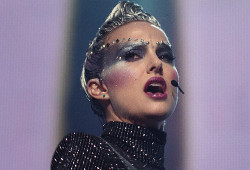 Brady Corbet’s sophomore effort, Vox Lux charts the adolescence and career of Lady Gaga-like pop star Celeste (Raffey Cassidy as an adolescent and Natalie Portman as an adult) and the impact her erratic behavior has on those in her orbit (including Jude Law’s sketchy manager and Stacy Martin's exasperated Eleanor). Filmmaker Corbet certainly does an astonishing job of immediately drawing the viewer into the (somewhat overlong) proceedings, as Vox Lux kicks off with an engrossing and incredibly stylish opening that seems to promise a truly singular cinematic experience. From there, though, the picture segues into deliberate narrative that’s often as tedious as it is captivating - with the ongoing inclusion of admittedly striking interludes compensating for the hit-and-miss atmosphere (eg a sequence detailing Celeste's exploits in Stockholm is presented in fast-forward). Corbet's unapologetically self-indulgent sensibilities are reflected most keenly in his proclivity for long, drawn-out sequences, and yet it’s hard to deny that the film succeeds completely as a low-key character study of an admittedly captivating figure - with this vibe certainly heightened by both Cassidy and Portman’s engrossing work as the central character (and it’s clear, as well, that both actresses deserve credit for their warts-and-all portrayal of a somewhat unlikable individual). The bizarre (and excessive) closing stretch, which operates as a mini concert held by Celeste, certainly confirms Vox Lux’s place as a seriously uneven piece of work, with the picture’s various highs ultimately compensating for its more overtly underwhelming elements.
out of


