Mini Reviews (July 2012)
Of Unknown Origin, The Switch, Ted, Abraham Lincoln: Vampire Hunter, V/H/S
Of Unknown Origin (July 2/12)
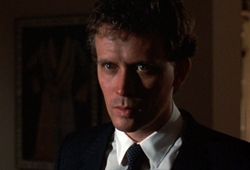 Of Unknown Origin follows Peter Weller's Bart Hughes as he's forced to put his life on hold after his recently-renovated townhouse is attacked by a tenacious rat, with Bart's subsequent (and failed) efforts at exterminating the rodent paving the way for a human-vs-rodent third act that's more ridiculous than frightening. Before it reaches that tedious stretch, however, Of Unknown Origin establishes itself as a fairly promising creature feature that benefits substantially from star Weller's compelling turn and director George P. Cosmatos' deliberate sensibilities - with, in terms of the latter, Cosmatos' decision to initially keep the rat in the shadows proving instrumental in cultivating an atmosphere of mysterious dread. It's only as the movie rolls into its increasingly repetitive and padded-out midsection that one's interest begins to wane, as Cosmatos attempts to compensate for the less-than-eventful storyline by emphasizing a whole host of frustratingly needless elements (eg Bart's ongoing difficulties at work, Bart's flirtation with a coworker, etc) - which does, as a result, ensure that the inevitable game of cat and mouse between Bart and the seemingly unstoppable rodent is simply unable to pack the visceral punch that Cosmatos and scripter Brian Taggert have intended. (This is despite the irresistible nature of Weller's progressively unhinged performance and the inclusion of a few strong stand-alone sequences.) It's ultimately clear that Of Unknown Origin might've worked as a half hour short yet is simply unable to sustain an 88 minute running time, with the spinning-its-wheels vibe diminishing the effectiveness of its positive attributes (eg a fantastic scene in which Bart horrifies his dining companions with grotesque rat statistics) and cementing its place as a forgettable relic of the 1980s. Of Unknown Origin follows Peter Weller's Bart Hughes as he's forced to put his life on hold after his recently-renovated townhouse is attacked by a tenacious rat, with Bart's subsequent (and failed) efforts at exterminating the rodent paving the way for a human-vs-rodent third act that's more ridiculous than frightening. Before it reaches that tedious stretch, however, Of Unknown Origin establishes itself as a fairly promising creature feature that benefits substantially from star Weller's compelling turn and director George P. Cosmatos' deliberate sensibilities - with, in terms of the latter, Cosmatos' decision to initially keep the rat in the shadows proving instrumental in cultivating an atmosphere of mysterious dread. It's only as the movie rolls into its increasingly repetitive and padded-out midsection that one's interest begins to wane, as Cosmatos attempts to compensate for the less-than-eventful storyline by emphasizing a whole host of frustratingly needless elements (eg Bart's ongoing difficulties at work, Bart's flirtation with a coworker, etc) - which does, as a result, ensure that the inevitable game of cat and mouse between Bart and the seemingly unstoppable rodent is simply unable to pack the visceral punch that Cosmatos and scripter Brian Taggert have intended. (This is despite the irresistible nature of Weller's progressively unhinged performance and the inclusion of a few strong stand-alone sequences.) It's ultimately clear that Of Unknown Origin might've worked as a half hour short yet is simply unable to sustain an 88 minute running time, with the spinning-its-wheels vibe diminishing the effectiveness of its positive attributes (eg a fantastic scene in which Bart horrifies his dining companions with grotesque rat statistics) and cementing its place as a forgettable relic of the 1980s.
  out of out of
The Switch (July 2/12)
 A conventional yet entertaining romantic comedy, The Switch follows Jason Bateman's Wally Mars as he's forced to stand idly by as his best friend (Jennifer Aniston's Kassie) prepares to have a baby with a sperm donor (Patrick Wilson's Roland) - despite the fact that Wally and Kassie clearly have romantic feelings for one another. It's Wally's drunken decision to switch Roland's sperm sample with his own that kicks the movie's shopworn plot into motion, as Wally is inevitably forced to confront his true feelings for Kassie after it becomes increasingly clear that he is the father of her son. It's immediately clear that directors Josh Gordon and Will Speck aren't looking to reinvent the wheel here, as the filmmakers have infused The Switch with an almost excessively familiar feel that's initially offset by the lighthearted atmosphere and Bateman's expectedly charismatic performance. (Aniston, on the other hand, is as stiff and unconvincing as ever.) The decidedly intriguing (and somewhat impossible-to-predict) plot twist involving Wally's switch effectively injects the proceedings with a burst of energy, and it's clear that the film, once it jumps ahead several years, gets plenty of mileage out of the palpable chemistry between Bateman's character and his five-year-old son (Thomas Robinson's Sebastian). There's little doubt, however, that the hackneyed turns in Allan Loeb's screenplay become more and more difficult to stomach as time progresses, with the movie's inevitable transformation into a stereotypical romcom, complete with a love triangle and fake break-up, ensuring that it ultimately peters out to a rather demonstrable degree. Still, The Switch, for the most part, comes off as a passable endeavor that benefits substantially from Bateman's ongoing efforts (as well as the efforts of an off-kilter supporting cast that includes Jeff Goldblum and Juliette Lewis). A conventional yet entertaining romantic comedy, The Switch follows Jason Bateman's Wally Mars as he's forced to stand idly by as his best friend (Jennifer Aniston's Kassie) prepares to have a baby with a sperm donor (Patrick Wilson's Roland) - despite the fact that Wally and Kassie clearly have romantic feelings for one another. It's Wally's drunken decision to switch Roland's sperm sample with his own that kicks the movie's shopworn plot into motion, as Wally is inevitably forced to confront his true feelings for Kassie after it becomes increasingly clear that he is the father of her son. It's immediately clear that directors Josh Gordon and Will Speck aren't looking to reinvent the wheel here, as the filmmakers have infused The Switch with an almost excessively familiar feel that's initially offset by the lighthearted atmosphere and Bateman's expectedly charismatic performance. (Aniston, on the other hand, is as stiff and unconvincing as ever.) The decidedly intriguing (and somewhat impossible-to-predict) plot twist involving Wally's switch effectively injects the proceedings with a burst of energy, and it's clear that the film, once it jumps ahead several years, gets plenty of mileage out of the palpable chemistry between Bateman's character and his five-year-old son (Thomas Robinson's Sebastian). There's little doubt, however, that the hackneyed turns in Allan Loeb's screenplay become more and more difficult to stomach as time progresses, with the movie's inevitable transformation into a stereotypical romcom, complete with a love triangle and fake break-up, ensuring that it ultimately peters out to a rather demonstrable degree. Still, The Switch, for the most part, comes off as a passable endeavor that benefits substantially from Bateman's ongoing efforts (as well as the efforts of an off-kilter supporting cast that includes Jeff Goldblum and Juliette Lewis).
out of
Ted (July 7/12)
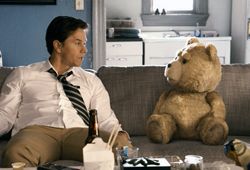 The first feature by Family Guy's Seth MacFarlane, Ted follows affable 35-year-old slacker John Bennett (Mark Wahlberg) as he's eventually forced to choose between Ted (MacFarlane), his fun-loving, sentient teddy bear, and his longtime girlfriend, Lori (Mila Kunis). MacFarlane, along with cowriters Alec Sulkin and Wellesley Wild, opens Ted with a remarkably engaging and entertaining prologue that immediately lures the viewer into the proceedings, with the lighthearted atmosphere subsequently perpetuated by charismatic performances and a smattering of genuinely hilarious comedic set pieces. (In terms of the former, it's the chemistry between John and Ted that stands as the movie's most potent weapon and one ultimately can't help but wish that MacFarlane had included more of their easygoing exploits.) There does reach a point, however, at which Ted's incongruously lackadaisical pace begins to become problematic, with the continuing emphasis on palpably needless subplots (eg Lori's dealings with her sleazy boss, Ted's efforts at avoiding a creepy collector, etc) ensuring that the film demonstrably runs out of steam as it rolls into its flabby midsection. (This is to say nothing of the hopelessly melodramatic stretch that occurs towards the end, as MacFarlane offers up a pair of fake break-ups that are nothing short of disastrous.) And although the movie picks up for its bizarre (yet effective, admittedly) action-oriented climax, Ted is, in the end, a terminally uneven and barely-passable debut from MacFarlane that, when compared to his superior work in television, can't help but come off as a serious disappointment. The first feature by Family Guy's Seth MacFarlane, Ted follows affable 35-year-old slacker John Bennett (Mark Wahlberg) as he's eventually forced to choose between Ted (MacFarlane), his fun-loving, sentient teddy bear, and his longtime girlfriend, Lori (Mila Kunis). MacFarlane, along with cowriters Alec Sulkin and Wellesley Wild, opens Ted with a remarkably engaging and entertaining prologue that immediately lures the viewer into the proceedings, with the lighthearted atmosphere subsequently perpetuated by charismatic performances and a smattering of genuinely hilarious comedic set pieces. (In terms of the former, it's the chemistry between John and Ted that stands as the movie's most potent weapon and one ultimately can't help but wish that MacFarlane had included more of their easygoing exploits.) There does reach a point, however, at which Ted's incongruously lackadaisical pace begins to become problematic, with the continuing emphasis on palpably needless subplots (eg Lori's dealings with her sleazy boss, Ted's efforts at avoiding a creepy collector, etc) ensuring that the film demonstrably runs out of steam as it rolls into its flabby midsection. (This is to say nothing of the hopelessly melodramatic stretch that occurs towards the end, as MacFarlane offers up a pair of fake break-ups that are nothing short of disastrous.) And although the movie picks up for its bizarre (yet effective, admittedly) action-oriented climax, Ted is, in the end, a terminally uneven and barely-passable debut from MacFarlane that, when compared to his superior work in television, can't help but come off as a serious disappointment.
out of
Abraham Lincoln: Vampire Hunter (July 7/12)
 Abraham Lincoln: Vampire Hunter follows the title character (Benjamin Walker) as he discovers that vampires are planning to take over the United States (and are, in fact, responsible for the death of his beloved mother), with the movie subsequently detailing Lincoln's progression from fledgling assassin to vampire-killing politician. It's an admittedly (and blatantly) ridiculous premise that's employed to surprisingly watchable effect at the outset, with Walker's strong performance initially compensating for the less-than-accomplished special effects and for Timur Bekmambetov's consistently wrongheaded directorial choices. (Bekmambetov's ineptness is especially problematic during the movie's action-oriented sequences, as the filmmaker suffuses such moments with a myriad of momentum-killing tricks - including handheld camerawork and an overuse of slow motion.) It's clear, too, that the movie benefits substantially from the chemistry between Lincoln and his mentor, Dominic Cooper's Henry, and there's little doubt that the film is, generally speaking, at its best during the pair's irresistibly over-the-top training sessions. Abraham Lincoln: Vampire Hunter doesn't begin to palpably begin to wear out its welcome until somewhere around the halfway mark, as the comparatively low-key nature of the protagonist's exploits are jettisoned in favor of an increasingly (and incongruously) epic story involving vampires in the Civil War. It's tedious stuff that results in a progressively stagnant atmosphere; once the movie rolls into its overblown, special-effects heavy, and flat-out interminable climax, Abraham Lincoln: Vampire Hunter has finally established itself as a missed opportunity that's rarely, if ever, as much fun as its title might've indicated. Abraham Lincoln: Vampire Hunter follows the title character (Benjamin Walker) as he discovers that vampires are planning to take over the United States (and are, in fact, responsible for the death of his beloved mother), with the movie subsequently detailing Lincoln's progression from fledgling assassin to vampire-killing politician. It's an admittedly (and blatantly) ridiculous premise that's employed to surprisingly watchable effect at the outset, with Walker's strong performance initially compensating for the less-than-accomplished special effects and for Timur Bekmambetov's consistently wrongheaded directorial choices. (Bekmambetov's ineptness is especially problematic during the movie's action-oriented sequences, as the filmmaker suffuses such moments with a myriad of momentum-killing tricks - including handheld camerawork and an overuse of slow motion.) It's clear, too, that the movie benefits substantially from the chemistry between Lincoln and his mentor, Dominic Cooper's Henry, and there's little doubt that the film is, generally speaking, at its best during the pair's irresistibly over-the-top training sessions. Abraham Lincoln: Vampire Hunter doesn't begin to palpably begin to wear out its welcome until somewhere around the halfway mark, as the comparatively low-key nature of the protagonist's exploits are jettisoned in favor of an increasingly (and incongruously) epic story involving vampires in the Civil War. It's tedious stuff that results in a progressively stagnant atmosphere; once the movie rolls into its overblown, special-effects heavy, and flat-out interminable climax, Abraham Lincoln: Vampire Hunter has finally established itself as a missed opportunity that's rarely, if ever, as much fun as its title might've indicated.
out of
V/H/S (July 20/12)
 A typically uneven horror anthology, V/H/S follows a group of trouble-making misfits as they attempt to track down a VHS tape contained within a creepy old apartment - with the movie subsequently consisting of five found-footage tales culled from random tapes found in said apartment. There's little doubt that V/H/S gets off to a palpably underwhelming start, as the film's wraparound story, directed by Adam Wingard, boasts an excessively low-rent feel that immediately establishes an atmosphere of jittery annoyance - with this vibe perpetuated by the outset of the first story, David Bruckner's Amateur Night. And while that tale admittedly does improve as it progresses, the remainder of the movie's installments suffer from a similar unevenness that is, to say the least, somewhat distracting and disheartening. Having said that, V/H/S admittedly does contain a number of striking and downright creepy moments - with the midsection of Ti West's Second Honeymoon, in particular, peppered with a smattering of impressively sinister images. (There's little doubt, however, that the short's impact is substantially diminished by its hopelessly conventional conclusion.) The next two tales, Glenn McQuaid's Tuesday the 17th and Joe Swanberg's The Sick Thing That Happened to Emily When She Was Younger - a tedious slasher and an incoherent webcam shocker, respectively - perpetuate V/H/S' decidedly erratic atmosphere, and although the film picks up with its final installment, Radio Silence's audacious and gleefully over-the-top 10/31/98, it's ultimately impossible to label the movie as anything more than a watchable yet overlong and meandering low-budget horror effort. A typically uneven horror anthology, V/H/S follows a group of trouble-making misfits as they attempt to track down a VHS tape contained within a creepy old apartment - with the movie subsequently consisting of five found-footage tales culled from random tapes found in said apartment. There's little doubt that V/H/S gets off to a palpably underwhelming start, as the film's wraparound story, directed by Adam Wingard, boasts an excessively low-rent feel that immediately establishes an atmosphere of jittery annoyance - with this vibe perpetuated by the outset of the first story, David Bruckner's Amateur Night. And while that tale admittedly does improve as it progresses, the remainder of the movie's installments suffer from a similar unevenness that is, to say the least, somewhat distracting and disheartening. Having said that, V/H/S admittedly does contain a number of striking and downright creepy moments - with the midsection of Ti West's Second Honeymoon, in particular, peppered with a smattering of impressively sinister images. (There's little doubt, however, that the short's impact is substantially diminished by its hopelessly conventional conclusion.) The next two tales, Glenn McQuaid's Tuesday the 17th and Joe Swanberg's The Sick Thing That Happened to Emily When She Was Younger - a tedious slasher and an incoherent webcam shocker, respectively - perpetuate V/H/S' decidedly erratic atmosphere, and although the film picks up with its final installment, Radio Silence's audacious and gleefully over-the-top 10/31/98, it's ultimately impossible to label the movie as anything more than a watchable yet overlong and meandering low-budget horror effort.
out of
|


